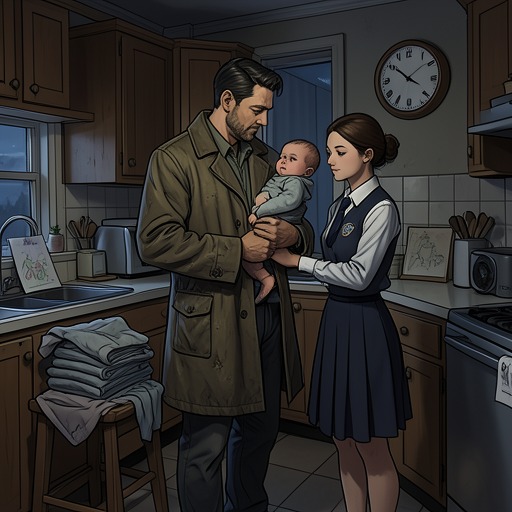
Single fatherhood
It Must Be Love: A Mustang Prairie RomanceSingle fatherhood is the central domestic condition shaping Jack Thorpe’s life after Marissa Thorpe’s death. He returns to Mustang Prairie so Abby Thorpe and Andie Thorpe can have the safe, idyllic childhood he remembers, yet the decision leaves him carrying grief, artistic frustration, household responsibility, and constant fear of losing the girls. His fatherhood begins as a defensive structure built around protection; over time, it becomes a route toward trust, community, and the possibility of loving again.
Identity and Background
Jack’s single-parent status follows Marissa Thorpe’s death and is inseparable from his identity as both an artist and a father. He had achieved extraordinary success with oil painting at twenty-two, selling dozens of works for large sums, but after returning to Mustang Prairie he found that the familiar medium no longer inspired him. His studio became a place of stalled effort: for a month he tried to paint something significant and produced only fruit, grass, flowers, and pictures of his daughters. The frustration is not merely professional. His return was a wise choice for Abby and Andie, but it has not given him a satisfying role beyond caring for them.
His experiments with metal and wood offer a revealing counterpoint to this creative paralysis. After seeing a strange metal table in the display window of the new lingerie shop on Fourth Street, he experiences a sudden breakthrough and begins constructing a chandelier. The work gives him a renewed sense of movement just as fatherhood interrupts it: a call informs him that Abby has not arrived at Busy Bees and never boarded the bus home. He immediately changes clothes, puts on shoes, calls Ty, and follows instructions, abandoning the studio without hesitation. The unfinished chandelier and the missing child occupy the same opening crisis, showing how quickly artistic identity gives way to paternal duty.
Protection and Its Limits
Jack’s greatest fear has been losing the girls since bringing Abby and Andie home from the hospital, and Marissa’s death intensifies that fear. When Abby disappears, reassurance from Shirl and Ty cannot dispel his terror. He accepts coffee and blackberry pie at Shirl’s diner while everyone who can is searching, but his hope that Abby is safe remains painfully uncertain. Andie’s arrival, with Dylan carrying her Little Buzzers uniform, makes the crisis a family emergency rather than a private panic. When Andie says Abby must be somewhere nearby, Jack comforts her by trusting Ty and Dylan to find her, even though he does not possess that confidence himself.
The same protective instinct produces conflict with Trixie Beaumont. Andie reveals that Abby often sneaks away to Trixie’s shop, and Jack discovers Abby there after she has been making a shrug with Trixie. His fear turns into anger. He treats the lingerie shop as an inappropriate and threatening space for a child, condemning Trixie for keeping other people’s children in what he calls her “dungeon of perversity.” The accusation is disproportionate, but it expresses the logic of his single fatherhood: unfamiliar environments and adults outside his control become potential dangers.
His conflict with Abby continues after the immediate incident. For nearly a month she pretends he does not exist, responding only to basic needs in a cool, detached manner that reminds him of Marissa. Jack recognizes that his daughter is miserable and knows that he has the power to repair the damage, yet he cannot simply command her back into emotional closeness. Her silence becomes a limit on paternal authority. He can provide safety, food, transport, and rules, but he cannot force trust.
The Girls’ Independence and Care
Jack’s relationship with Abby changes when he takes her to the Mustang Prairie Community Center for a ninety-minute knitting and sewing class. He offers to walk her inside and waits for confirmation that she is comfortable, but Abby insists that she will be fine because Trixie will not let anything happen to her. Her confidence warms him, while her reliance on Trixie makes him wonder whether she is becoming too close to her. The moment contains both progress and unease: Jack has raised a daughter capable of independence, but independence means that care is no longer exclusively organized through him.
Abby’s wish to make a hat like Marissa’s makes that independence emotional as well as practical. She finds a photograph in the basement and brings it to Trixie, explaining that Jack will not let her come to the store and that she is unsure whether she can finish the hat alone. The photograph turns a craft project into an act of memory. Abby is trying to reproduce an object associated with her mother, while Jack’s restriction inadvertently keeps her from the person who can help her do so. Trixie promises to work it out but tells Abby to clear the matter with her father, preserving his parental authority even while offering the understanding he cannot provide in that moment.
The girls also become active interpreters of their father’s emotional life. At Christmas, Abby tells Jack that apologizing is what he must do when someone’s feelings have been hurt. When he asks who hurt her feelings, she answers that plenty of people have and insists that she is nearly a teenager. She then holds his face and tells him to apologize to Trixie, because she and Andie know that he likes her. The children therefore reverse the usual direction of care: the father who believes he must manage everyone’s safety is taught by his daughters how to repair an adult relationship.
Community and Reconfigured Family
Jack’s household gradually expands beyond the narrow unit of widower and children. A Thanksgiving gathering fills his house for the first time since the girls were babies. His parents remain in Mustang Prairie for the festivals and holiday parties; Sadie and Dylan bring side dishes; Luna arrives with ham while holding Mr. Scanlan’s hand; and Jonquil comes early with Abby and Andie to learn the family’s Thanksgiving traditions. The crowded house gives Jack a glimpse of family life that is sustained not only by blood but by friends, neighbors, and newcomers.
Trixie’s place in this wider structure is especially complicated. Jack believes that he and Trixie have an understanding that they can enjoy their relationship for as long as it lasts, but after Thanksgiving she avoids him, arriving only ten minutes before the meal and disappearing whenever he comes to collect the girls from her home. Her distance unsettles him because the girls continue to see her and report on her, keeping her present within his household even when she refuses direct contact. Single fatherhood thus becomes a networked condition: Jack’s children connect him to Trixie, Jonquil, Sadie, Dylan, and the broader community whether he is emotionally prepared for those connections or not.
His mother identifies the deeper obstacle. She tells him that Trixie cannot compete with the ghost of Marissa and urges him to tell Trixie the truth about his marriage. Jack’s resistance to marriage is rooted in the belief that his experience with Marissa proves marriage itself to be dangerous, although his mother challenges that conclusion by distinguishing their troubled relationship from the genuinely mutual marriage she shared with Jack’s father. Her intervention reframes Jack’s single fatherhood: he is not simply protecting his daughters from instability, but also protecting himself from repeating a failed marriage.
Change and Narrative Significance
Jack’s fatherhood begins in vigilance and control but increasingly requires emotional honesty. He objects to Trixie’s influence, yet the girls trust her. He wants Abby to remain safe, yet Abby’s confidence depends partly on being allowed to learn with Trixie. He wants to preserve the family Marissa’s death destroyed, yet the household becomes healthier when it admits new people and new forms of care. The contradiction is productive: Jack cannot remain both the sole guardian of the girls’ emotional world and the man who wants a future beyond widowhood.
His romantic movement toward Trixie develops alongside this domestic reorientation. Despite warnings from all his friends against pursuing anything casual with her, he stops at her house and asks her out. Their dinner follows earlier sex, conflict, and a decision not to repeat the encounter, so the date exposes how poorly Jack’s rules contain his desires. Trixie arrives nervous in a white tank top, red bra, black leather pants, knee-high boots, and a black leather jacket; Jack appears in a cream sweater and black pants. Their attraction is immediate, but the stakes are enlarged by the children, who already treat Trixie as a trusted presence.
At Trixie’s brand-launch celebration, Jack congratulates her, only to find her emotionally guarded. Later he understands that he had failed to invite her to his own opening and had wrongly interpreted her absence as a repetition of Marissa’s unwillingness to support him. He explains that he spent the night looking for Trixie and could not enjoy the success of the exhibition because he had convinced himself that he did not love her. The admission marks a decisive change in his single fatherhood: he begins to recognize that love for Trixie does not erase Marissa, diminish his daughters, or cancel his responsibility as a parent. It offers a different model of family life, one in which protection can coexist with trust, memory with change, and fatherhood with a renewed capacity for intimacy.